Sunday, July 1, 2012
Windows Phone rumors ramp up in advance of Mobile World Congress
The Mobile World Congress in Barcelona next week looks like it will play host to the usual range of exciting announcements in the mobile devices and software field. Based on the continued appearance of enticing rumors, Microsoft's Windows Phone platform looks like it will be one of the main attractions this year.
At 9:00 A.M. Eastern Standard Time, CEO Steve Ballmer is expected host a press conference unveiling the latest Windows Mobile developments, which could be anything from the official announcement of Windows Mobile 6.5.3 to the launch of Xbox Live-enabled games on Windows Mobile to a so-called "Zune Phone."
Reuters today cited anonymous sources who said the announcement will be "new mobile phone software," an aggravatingly vague description, which The Wall Street Journal tightened up into "Windows Mobile 7," which it says will resemble the Zune HD's interface, but all signs seem to be pointing elsewhere.
Microsoft assured us last month that its user-friendly, non-legacy mobile operating system was NOT Windows Mobile 7, and a report from Bloomberg today eliminated its mention of Windows Mobile 7 in favor of "The renamed Windows Phone operating system."
A new version of Windows Mobile that concentrates on media and entertainment instead of business functionality would no doubt be welcome in the new consumer-driven smartphone market, and many would say it's long overdue from Redmond.
At 9:00 A.M. Eastern Standard Time, CEO Steve Ballmer is expected host a press conference unveiling the latest Windows Mobile developments, which could be anything from the official announcement of Windows Mobile 6.5.3 to the launch of Xbox Live-enabled games on Windows Mobile to a so-called "Zune Phone."
Reuters today cited anonymous sources who said the announcement will be "new mobile phone software," an aggravatingly vague description, which The Wall Street Journal tightened up into "Windows Mobile 7," which it says will resemble the Zune HD's interface, but all signs seem to be pointing elsewhere.
Microsoft assured us last month that its user-friendly, non-legacy mobile operating system was NOT Windows Mobile 7, and a report from Bloomberg today eliminated its mention of Windows Mobile 7 in favor of "The renamed Windows Phone operating system."
A new version of Windows Mobile that concentrates on media and entertainment instead of business functionality would no doubt be welcome in the new consumer-driven smartphone market, and many would say it's long overdue from Redmond.

Saturday, June 30, 2012
Nokia announced new additions to its Symbian 3 family
Nokia announced new additions to its Symbian^3 family of devices at the ongoing Nokia World in London. The announcement of the three new models takes the Symbian^3 device count to four.
Joining the Nokia N8, announced in April this year, are the Nokia E7 and two new entrants to the C series - C6-01 and C7.
The Nokia E7 is a business device boasts of a 4-inch touchscreen display and a slide out four-row keyboard. The E7 comes with an 8 megapixel camera and 16GB of on-board storage. The device is able to shoot and edit 720p video.
The business features of the E7 include support for Microsoft Exchange ActiveSync, Mail for Exchange, Microsoft Communicator Mobile and Microsoft Share Point Server.
With 18 days of standby time and up to 9 hours of talktime, the E7 is expected be available by the end of 2010 at a price of € 495 (Rs 29,500).
The new entrant to Nokia's C-family, the C7 has a 3.5-inch AMOLED and comes with an 8 megapixel camera along with 8GB of onboard storage. The C7 is expected to be priced at about € 335 (Rs 20,000).
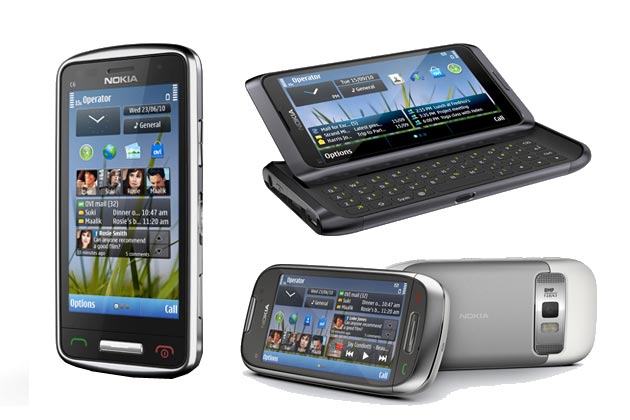
The compact Nokia C6-01 also has an 8 megapixel camera. The device with a 3.2-inch AMOLED capacitive touchscreen and has the Nokia ClearBlack technology, also used in the E7, for improved outdoor visibility. The C6-01 is expected to be available for € 260 (Rs 15,500).
Nokia is in the middle of a major management revamp, with the departures of its chief executive and chairman announced last week and its top internal candidate for the CEO post resigning on Monday.
Nokia still controls around 40 percent of the global smartphone market volume, but has lost out to Apple and Research in Motion's Blackberry in the fatter-margin market for the most expensive cellphone models.
Saturday, June 16, 2012
HTC Tattoo to launch in OctoberLatest Android mobile to be available on Vodafone
The HTC Tattoo will launch next month, however keen customers are already able to pre-order the Android-based mobile phone from Vodafone.
The HTC Tattoo is the latest mobile phone to be announced that will run on Google's Android operating system, which allows owners of Android-based mobile phones to access thousands of applications downloadable from the Android market.
HTC Sense interface
The phone also runs on the HTC Sense interface, which offers users a number of customisable homescreens. More about the Sense interface can be found in the HTC Hero first look video.
While Vodafone hasn't yet confirmed the price or contract details of the Tattoo, the handset is expected to be more affordably priced than the previous three HTC Android phones: the G1, the HTC Magic, and the HTC Hero.
HTC Tattoo specification
The Tattoo's specifications include a 3.2Mp camera, a 2.8-inch touchscreen, Wi-Fi, 3G and GPS connectivity. The Tattoo also has an MP3 player and radio - and a welcome 3.5mm headphone socket so you can use the headphones of your choice.
Jon Barrow, Which? mobile phone expert, said: 'We hope that the rumours about the Tattoo being a more affordable handset are accurate, as it would be great to bring the Android market to a wider market. We look forward to testing this device in our labs sometime soon'.
Android mobile phone handsets
HTC currently dominates the market with Android-powered mobile phones, but this is set to change with models from Samsung, LG and Sony Ericsson on the not too distant horizon. A first look of the Android Samsung Galaxy can be read in our mobile phone report, and a first look video of the Galaxy can be viewed in our IFA 2009 report from the consumer electronics show in Berlin.
The HTC Tattoo is the latest mobile phone to be announced that will run on Google's Android operating system, which allows owners of Android-based mobile phones to access thousands of applications downloadable from the Android market.
HTC Sense interface
The phone also runs on the HTC Sense interface, which offers users a number of customisable homescreens. More about the Sense interface can be found in the HTC Hero first look video.
While Vodafone hasn't yet confirmed the price or contract details of the Tattoo, the handset is expected to be more affordably priced than the previous three HTC Android phones: the G1, the HTC Magic, and the HTC Hero.
HTC Tattoo specification
The Tattoo's specifications include a 3.2Mp camera, a 2.8-inch touchscreen, Wi-Fi, 3G and GPS connectivity. The Tattoo also has an MP3 player and radio - and a welcome 3.5mm headphone socket so you can use the headphones of your choice.
Jon Barrow, Which? mobile phone expert, said: 'We hope that the rumours about the Tattoo being a more affordable handset are accurate, as it would be great to bring the Android market to a wider market. We look forward to testing this device in our labs sometime soon'.
Android mobile phone handsets
HTC currently dominates the market with Android-powered mobile phones, but this is set to change with models from Samsung, LG and Sony Ericsson on the not too distant horizon. A first look of the Android Samsung Galaxy can be read in our mobile phone report, and a first look video of the Galaxy can be viewed in our IFA 2009 report from the consumer electronics show in Berlin.
Friday, June 15, 2012
Motorola launches second Android phone
Motorola Inc. introduced its second phone based on Google Inc.’s Android software, fighting for a bigger share of the growing market for Web-equipped phones to reverse more than a year of sales declines.

Read more »

The phone, called the Droid, features a larger screen than Apple Inc.’s top-selling iPhone and has higher resolution.
The phone, called the Droid, features a larger screen than Apple Inc.’s top-selling iPhone and has higher resolution, said co-chief executive Sanjay Jha. It will be available Nov. 6 on the Verizon Wireless website and in retail stores, Motorola said. The price will be US$199.99 with a two-year agreement after a US$100 mail-in rebate.
Motorola is rebuilding its mobile-phone division around the Android operating system to entice consumers who abandoned its handsets in favour of the iPhone and Research In Motion Ltd.’s BlackBerry. Motorola’s share of the phone market dropped by almost half in the second quarter from 10% a year earlier, according to Gartner Inc.
“We’ve been missing from the market,” Mr. Jha, 46, said in an interview. The Droid “absolutely does” get Motorola back into the game with a better operating system and a faster Internet browser, he said.
Based on Android 2.0, a newer version of the Google operating system, the device allows users to run multiple applications at once, features voice-driven Web searches, and has one of the “fastest Web browsers available today,” Mr. Jha said.
T-Mobile USA Inc. will begin selling the Schaumburg, Ill.-based company’s first Android phone, the Cliq, on Nov. 2 for US$199.99 with a two-year contract.
“Droid boasts impressive specs and reviews from the blog community have been very favourable thus far,” said Matt Thornton, an analyst with Avian Securities LLC in Boston. “This should give some indication as to how the device will be received by the consumer, the press and the investor community.” Thornton has a “positive” rating on the stock.
Motorola plans more Android devices. At least one of those will be sold through a third carrier, Mr. Jha said. The Droid will be available through multiple carriers outside the U.S. later this year, he said.
Mr. Jha declined to comment on how Android phones will affect earnings. The company will report third-quarter results tomorrow. Analysts predict profit of less than 1 cent a share, excluding some items, the average of estimates in a Bloomberg survey.
Thursday, June 14, 2012
TIMELINE: Motorola banks on Google phones for comeback
Motorola Inc, seeking to regain market share, unveiled a cellphone on Thursday based on Google Inc's Android mobile software, in what is viewed as the handset maker's most important product launch in years.
Here is a look at Motorola's highs and lows over the years.
* 1928: Galvin family establishes Galvin Manufacturing. Its first product was a power converter.
* 1930: Changes name to Motorola. Three generations of Galvins lead Motorola until Christopher Galvin's 2004 ouster.
* 1943: First public offering of Motorola stock for $8.50.
* 1973: Motorola's Martin Cooper makes the first mobile phone call on a prototype of DynaTAC.
* 1984: DynaTAC becomes commercially available. It is later known as the "brick" when surpassed by lighter, smaller phones.
* 1989: Launches its first flip-phone, MicroTAC, which has a plastic cover that flips open to reveal its keypad.
* 1994: Motorola dominates cell market with a 32.5 percent share, versus Nokia's 21 percent, according to Gartner.
* Mid-1990s: The first digital wireless networks are built in Europe, but Motorola is slow to discard analog for digital.
* 1996: Launch of StarTAC, first of Motorola's clamshells with a lid that hinges open to reveal screen and keypad. It is popular, but Motorola's market share still slips that year.
* 2000: Motorola's market share is now 13 percent versus Nokia's 31 percent, according to Gartner. Motorola's market share hovers in mid-teen range for next few years.
* 2004: Late in the year Motorola launches Razr, an ultra-thin phone that quickly becomes a design icon. It is promoted by Cingular, now part of AT&T Inc.
* 2006: In July, Motorola says it has sold 50 million Razr phones and CEO Ed Zander promises sales of 500 million. But by late 2006, carriers are heavily discounting Razr. Some give it away to attract new subscribers. Motorola results start to disappoint and its market share peaks around 23 percent.
* 2007: Motorola shocks with a big first-quarter loss and its market share drops to 17 percent. Activist investor Carl Icahn begins pushing for the company to split up, buy back shares and fire its CEO. By July, the clamor for Zander's ouster increases after Motorola posts its second quarterly loss in a row and Apple Inc ups the ante with the launch of the iPhone. Motorola ends 2007 with 9 percent market share.
* January 2008: Greg Brown replaces Zander as CEO. Motorola posts a loss for three out of four quarters of that year.
* February 2008: Motorola says to spin off phone unit. Plan has since been postponed to "beyond 2009" amid continuing losses in its cellphone unit.
* April 2008: Motorola ends Icahn proxy battle.
* August 2008: Sanjay Jha becomes Brown's Co-CEO and head of mobile devices. Analysts, investors applaud the choice.
* October 2008: Jha reveals plan for Android phones, thousands of job cuts and refocusing Motorola on fewer operating systems. Motorola ends the year with less than 7 percent market share.
* December 2008: Jha, Brown promise to cut their own salaries by 25 percent.
* 2009: Motorola investors flee after a first-quarter loss, but the stock rallies again on a second-quarter profit. Jha's progress reports help push Motorola shares up more than 150 percent to a close of $7.85 on Wednesday, September 9, from a March low of $3.10.
* August 2009: Motorola flags September 10 Android announcement. Shares jump 11 percent in a single day ahead of the news.
* September 10: Motorola unveils Android phone.
Here is a look at Motorola's highs and lows over the years.
* 1928: Galvin family establishes Galvin Manufacturing. Its first product was a power converter.
* 1930: Changes name to Motorola. Three generations of Galvins lead Motorola until Christopher Galvin's 2004 ouster.
* 1943: First public offering of Motorola stock for $8.50.
* 1973: Motorola's Martin Cooper makes the first mobile phone call on a prototype of DynaTAC.
* 1984: DynaTAC becomes commercially available. It is later known as the "brick" when surpassed by lighter, smaller phones.
* 1989: Launches its first flip-phone, MicroTAC, which has a plastic cover that flips open to reveal its keypad.
* 1994: Motorola dominates cell market with a 32.5 percent share, versus Nokia's 21 percent, according to Gartner.
* Mid-1990s: The first digital wireless networks are built in Europe, but Motorola is slow to discard analog for digital.
* 1996: Launch of StarTAC, first of Motorola's clamshells with a lid that hinges open to reveal screen and keypad. It is popular, but Motorola's market share still slips that year.
* 2000: Motorola's market share is now 13 percent versus Nokia's 31 percent, according to Gartner. Motorola's market share hovers in mid-teen range for next few years.
* 2004: Late in the year Motorola launches Razr, an ultra-thin phone that quickly becomes a design icon. It is promoted by Cingular, now part of AT&T Inc.
* 2006: In July, Motorola says it has sold 50 million Razr phones and CEO Ed Zander promises sales of 500 million. But by late 2006, carriers are heavily discounting Razr. Some give it away to attract new subscribers. Motorola results start to disappoint and its market share peaks around 23 percent.
* 2007: Motorola shocks with a big first-quarter loss and its market share drops to 17 percent. Activist investor Carl Icahn begins pushing for the company to split up, buy back shares and fire its CEO. By July, the clamor for Zander's ouster increases after Motorola posts its second quarterly loss in a row and Apple Inc ups the ante with the launch of the iPhone. Motorola ends 2007 with 9 percent market share.
* January 2008: Greg Brown replaces Zander as CEO. Motorola posts a loss for three out of four quarters of that year.
* February 2008: Motorola says to spin off phone unit. Plan has since been postponed to "beyond 2009" amid continuing losses in its cellphone unit.
* April 2008: Motorola ends Icahn proxy battle.
* August 2008: Sanjay Jha becomes Brown's Co-CEO and head of mobile devices. Analysts, investors applaud the choice.
* October 2008: Jha reveals plan for Android phones, thousands of job cuts and refocusing Motorola on fewer operating systems. Motorola ends the year with less than 7 percent market share.
* December 2008: Jha, Brown promise to cut their own salaries by 25 percent.
* 2009: Motorola investors flee after a first-quarter loss, but the stock rallies again on a second-quarter profit. Jha's progress reports help push Motorola shares up more than 150 percent to a close of $7.85 on Wednesday, September 9, from a March low of $3.10.
* August 2009: Motorola flags September 10 Android announcement. Shares jump 11 percent in a single day ahead of the news.
* September 10: Motorola unveils Android phone.
Tuesday, June 12, 2012
iPhone Hobbled by High Prices in Japan, Lack of 3G in India
Apple's iPhone may be giving competitors a run for their money in North America but when it comes to three of the biggest telecom markets in Asia — Japan, India and China — the company seems to be coming up lame.
The latest sales figures suggest the Jesus phone is struggling to find new converts in Japan. Not far away in India (the second largest telecom market after China) sales of the device are also lackluster thanks to prices that are pushing seven Benjamins for the entry level 8-GB version. And Apple has yet to finalize a deal with Chinese telecom carrier, China Mobile, to bring the iPhone to the People’s Republic.
A combination of high pricing and a marketing strategy that fails to take into account the needs of local markets has left Apple selling just a few hundred thousand units in countries where millions of other phones are sold every month.
Take India, one of Asia's fastest-growing telecom markets. Between 2006 and 2007, sales of smartphones within the nation grew an estimated 31.4 percent. The data-centric convergence device segment exploded at 89 percent, while voice-centric devices shot up by 26.3 percent. As of July 2008, the Telecom Regulatory Authority of India reported total wireless subscribers of about 296 million. About 9.2 million subscribers were added in July alone.
Nokia is the market leader in India but other players like Research In Motion (makers of Ur-smartphone BlackBerry), HTC and Sony Ericsson are gaining traction. But not Apple.
It isn't for lack of interest in the iPhone, says Naveen Mishra, an analyst at IDC India.
Apple's brand and the iPhone's design have captivated Indian consumers but the high cost of the device and the lack of a nationwide 3G network has kept away users from buying the phone.
"The iPhone has a large fan following," says Mishra, "but when it comes to buying the device not a lot of people want to spend that kind of money."
Apple CEO Steve Jobs introduced the 3G iPhone with the promise of $199 price tag at which it retails in the United States along with a two-year contract with the service provider.
But in India the device has been priced much higher at 31,000 Rupees ($673) for the 8-GB version and 36,100 Rupees ($785) for the 16-GB model.
The reason for the higher cost? Wireless customers in India flat out refuse to sign legally binding mobile phone contracts. Because they’re not obligated to stick with a service provider, handsets on the subcontinent are always full priced, never subsidized.
The iPhone's limited availability through a contract with just two mobile service operators has cramped sales, says Mishra.
Unlike the United States, India's telecom market is skewed in favor of prepaid users, who comprise at least 70 percent of total cellphone users in the country.
Most cellphone users in India buy their handsets from a retail store and activate it with the carrier of their choice; cellphones are generally sold unlocked.
The iPhone is the exception. It is currently available only on Airtel and Vodafone leaving potential iPhone buyers with limited options. India does not offer number portability and switching carriers means existing users could lose their phone number as they move to a new carrier.
India also does not have the 3G … yet. Analysts expect the first 3G networks in the country to be available mid-2009.
For the iPhone in India, sales are unlikely to pick up unless the service providers slash the price of the device, make it available through retail stores and launch their 3G network, says Mishra.
"There's going to be very limited uptake for the device unless the carriers do one or all of these things," says Mishra.
Despite weak sales, it is unlikely Apple will push for significant price cuts in the country, say analysts. "Apple throughout its family is willing to forgo large market share for profitable market share," says Ezra Gottheil, an analyst with Technology Business Research.
Meanwhile in Japan, Apple has partnered with Softbank, Japan's third-largest mobile service provider to sell the iPhone 3G. After the initial buzz, demand for the iPhone has fallen to a third of what it was as users cringe at the high cost of ownership for the phone and the unavailability of some features, says a report in The Wall Street Journal.
As for China, despite speculation, Apple seems no closer to signing a deal with China Mobile to offer the iPhone 3G in the market.
For Apple, it may be time to take a closer look at its business in Asia. Unless the company can move swiftly to change its strategy, it may find itself locked out of the largest telecom markets of the world.
The latest sales figures suggest the Jesus phone is struggling to find new converts in Japan. Not far away in India (the second largest telecom market after China) sales of the device are also lackluster thanks to prices that are pushing seven Benjamins for the entry level 8-GB version. And Apple has yet to finalize a deal with Chinese telecom carrier, China Mobile, to bring the iPhone to the People’s Republic.
A combination of high pricing and a marketing strategy that fails to take into account the needs of local markets has left Apple selling just a few hundred thousand units in countries where millions of other phones are sold every month.
Take India, one of Asia's fastest-growing telecom markets. Between 2006 and 2007, sales of smartphones within the nation grew an estimated 31.4 percent. The data-centric convergence device segment exploded at 89 percent, while voice-centric devices shot up by 26.3 percent. As of July 2008, the Telecom Regulatory Authority of India reported total wireless subscribers of about 296 million. About 9.2 million subscribers were added in July alone.
Nokia is the market leader in India but other players like Research In Motion (makers of Ur-smartphone BlackBerry), HTC and Sony Ericsson are gaining traction. But not Apple.
It isn't for lack of interest in the iPhone, says Naveen Mishra, an analyst at IDC India.
Apple's brand and the iPhone's design have captivated Indian consumers but the high cost of the device and the lack of a nationwide 3G network has kept away users from buying the phone.
"The iPhone has a large fan following," says Mishra, "but when it comes to buying the device not a lot of people want to spend that kind of money."
Apple CEO Steve Jobs introduced the 3G iPhone with the promise of $199 price tag at which it retails in the United States along with a two-year contract with the service provider.
But in India the device has been priced much higher at 31,000 Rupees ($673) for the 8-GB version and 36,100 Rupees ($785) for the 16-GB model.
The reason for the higher cost? Wireless customers in India flat out refuse to sign legally binding mobile phone contracts. Because they’re not obligated to stick with a service provider, handsets on the subcontinent are always full priced, never subsidized.
The iPhone's limited availability through a contract with just two mobile service operators has cramped sales, says Mishra.
Unlike the United States, India's telecom market is skewed in favor of prepaid users, who comprise at least 70 percent of total cellphone users in the country.
Most cellphone users in India buy their handsets from a retail store and activate it with the carrier of their choice; cellphones are generally sold unlocked.
The iPhone is the exception. It is currently available only on Airtel and Vodafone leaving potential iPhone buyers with limited options. India does not offer number portability and switching carriers means existing users could lose their phone number as they move to a new carrier.
India also does not have the 3G … yet. Analysts expect the first 3G networks in the country to be available mid-2009.
For the iPhone in India, sales are unlikely to pick up unless the service providers slash the price of the device, make it available through retail stores and launch their 3G network, says Mishra.
"There's going to be very limited uptake for the device unless the carriers do one or all of these things," says Mishra.
Despite weak sales, it is unlikely Apple will push for significant price cuts in the country, say analysts. "Apple throughout its family is willing to forgo large market share for profitable market share," says Ezra Gottheil, an analyst with Technology Business Research.
Meanwhile in Japan, Apple has partnered with Softbank, Japan's third-largest mobile service provider to sell the iPhone 3G. After the initial buzz, demand for the iPhone has fallen to a third of what it was as users cringe at the high cost of ownership for the phone and the unavailability of some features, says a report in The Wall Street Journal.
As for China, despite speculation, Apple seems no closer to signing a deal with China Mobile to offer the iPhone 3G in the market.
For Apple, it may be time to take a closer look at its business in Asia. Unless the company can move swiftly to change its strategy, it may find itself locked out of the largest telecom markets of the world.
Monday, June 11, 2012
Sony Ericsson launches green business phone
Sony Ericsson today announced a new business mobile phone with eco features to complete its GreenHeart portfolio. Sony Ericsson Aspen is a touchscreen device equipped with a QWERTY keyboard and the latest version of Windows Mobile.
“Sony Ericsson Aspen is the business phone with a conscience, suitable for any consumer or company who want to make a green choice in their daily work life”, said Quentin Cordier, Global Marketing Manager, Sony Ericsson.
The latest addition to GreenHeart portfolio uses customizable panels and Slide View for quick access to common features, has a keyboard made for fast and easy typing, simple email setup and multi-tasking capabilities, saving time and energy when performing business-related tasks.
Apart from its green business credentials, Aspen benefits from a Media browser and PlayNow feature which allows simple access to social networks and quick and easy access to media files, GPS, Google Maps and a 3.2 megapixel camera.
In addition to that, Microsoft MyPhone service is pre-installed to secure the phone’s content, which remotely erases phone data when the handset is lost or stolen.
Sony Ericsson Aspen will be available in selected markets from the second quarter of 2010, in two colours: Iconic Black and White Silver.
The phone comes with an optional Bluetooth™ Noise Shield Handsfree VH700 and an eco-friendly charger, Energy Saving Mini-Charger EP800.
Read more »
“Sony Ericsson Aspen is the business phone with a conscience, suitable for any consumer or company who want to make a green choice in their daily work life”, said Quentin Cordier, Global Marketing Manager, Sony Ericsson.
The latest addition to GreenHeart portfolio uses customizable panels and Slide View for quick access to common features, has a keyboard made for fast and easy typing, simple email setup and multi-tasking capabilities, saving time and energy when performing business-related tasks.
Apart from its green business credentials, Aspen benefits from a Media browser and PlayNow feature which allows simple access to social networks and quick and easy access to media files, GPS, Google Maps and a 3.2 megapixel camera.
In addition to that, Microsoft MyPhone service is pre-installed to secure the phone’s content, which remotely erases phone data when the handset is lost or stolen.
Sony Ericsson Aspen will be available in selected markets from the second quarter of 2010, in two colours: Iconic Black and White Silver.
The phone comes with an optional Bluetooth™ Noise Shield Handsfree VH700 and an eco-friendly charger, Energy Saving Mini-Charger EP800.
Subscribe to:
Posts (Atom)