Showing posts with label smartphone. Show all posts
Showing posts with label smartphone. Show all posts
Sunday, July 1, 2012
Windows Phone rumors ramp up in advance of Mobile World Congress
The Mobile World Congress in Barcelona next week looks like it will play host to the usual range of exciting announcements in the mobile devices and software field. Based on the continued appearance of enticing rumors, Microsoft's Windows Phone platform looks like it will be one of the main attractions this year.
At 9:00 A.M. Eastern Standard Time, CEO Steve Ballmer is expected host a press conference unveiling the latest Windows Mobile developments, which could be anything from the official announcement of Windows Mobile 6.5.3 to the launch of Xbox Live-enabled games on Windows Mobile to a so-called "Zune Phone."
Reuters today cited anonymous sources who said the announcement will be "new mobile phone software," an aggravatingly vague description, which The Wall Street Journal tightened up into "Windows Mobile 7," which it says will resemble the Zune HD's interface, but all signs seem to be pointing elsewhere.
Microsoft assured us last month that its user-friendly, non-legacy mobile operating system was NOT Windows Mobile 7, and a report from Bloomberg today eliminated its mention of Windows Mobile 7 in favor of "The renamed Windows Phone operating system."
A new version of Windows Mobile that concentrates on media and entertainment instead of business functionality would no doubt be welcome in the new consumer-driven smartphone market, and many would say it's long overdue from Redmond.
At 9:00 A.M. Eastern Standard Time, CEO Steve Ballmer is expected host a press conference unveiling the latest Windows Mobile developments, which could be anything from the official announcement of Windows Mobile 6.5.3 to the launch of Xbox Live-enabled games on Windows Mobile to a so-called "Zune Phone."
Reuters today cited anonymous sources who said the announcement will be "new mobile phone software," an aggravatingly vague description, which The Wall Street Journal tightened up into "Windows Mobile 7," which it says will resemble the Zune HD's interface, but all signs seem to be pointing elsewhere.
Microsoft assured us last month that its user-friendly, non-legacy mobile operating system was NOT Windows Mobile 7, and a report from Bloomberg today eliminated its mention of Windows Mobile 7 in favor of "The renamed Windows Phone operating system."
A new version of Windows Mobile that concentrates on media and entertainment instead of business functionality would no doubt be welcome in the new consumer-driven smartphone market, and many would say it's long overdue from Redmond.

Saturday, June 30, 2012
Nokia announced new additions to its Symbian 3 family
Nokia announced new additions to its Symbian^3 family of devices at the ongoing Nokia World in London. The announcement of the three new models takes the Symbian^3 device count to four.
Joining the Nokia N8, announced in April this year, are the Nokia E7 and two new entrants to the C series - C6-01 and C7.
The Nokia E7 is a business device boasts of a 4-inch touchscreen display and a slide out four-row keyboard. The E7 comes with an 8 megapixel camera and 16GB of on-board storage. The device is able to shoot and edit 720p video.
The business features of the E7 include support for Microsoft Exchange ActiveSync, Mail for Exchange, Microsoft Communicator Mobile and Microsoft Share Point Server.
With 18 days of standby time and up to 9 hours of talktime, the E7 is expected be available by the end of 2010 at a price of € 495 (Rs 29,500).
The new entrant to Nokia's C-family, the C7 has a 3.5-inch AMOLED and comes with an 8 megapixel camera along with 8GB of onboard storage. The C7 is expected to be priced at about € 335 (Rs 20,000).
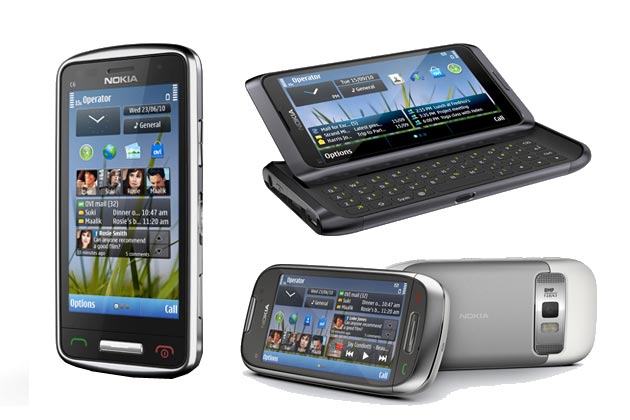
The compact Nokia C6-01 also has an 8 megapixel camera. The device with a 3.2-inch AMOLED capacitive touchscreen and has the Nokia ClearBlack technology, also used in the E7, for improved outdoor visibility. The C6-01 is expected to be available for € 260 (Rs 15,500).
Nokia is in the middle of a major management revamp, with the departures of its chief executive and chairman announced last week and its top internal candidate for the CEO post resigning on Monday.
Nokia still controls around 40 percent of the global smartphone market volume, but has lost out to Apple and Research in Motion's Blackberry in the fatter-margin market for the most expensive cellphone models.
Tuesday, June 12, 2012
iPhone Hobbled by High Prices in Japan, Lack of 3G in India
Apple's iPhone may be giving competitors a run for their money in North America but when it comes to three of the biggest telecom markets in Asia — Japan, India and China — the company seems to be coming up lame.
The latest sales figures suggest the Jesus phone is struggling to find new converts in Japan. Not far away in India (the second largest telecom market after China) sales of the device are also lackluster thanks to prices that are pushing seven Benjamins for the entry level 8-GB version. And Apple has yet to finalize a deal with Chinese telecom carrier, China Mobile, to bring the iPhone to the People’s Republic.
A combination of high pricing and a marketing strategy that fails to take into account the needs of local markets has left Apple selling just a few hundred thousand units in countries where millions of other phones are sold every month.
Take India, one of Asia's fastest-growing telecom markets. Between 2006 and 2007, sales of smartphones within the nation grew an estimated 31.4 percent. The data-centric convergence device segment exploded at 89 percent, while voice-centric devices shot up by 26.3 percent. As of July 2008, the Telecom Regulatory Authority of India reported total wireless subscribers of about 296 million. About 9.2 million subscribers were added in July alone.
Nokia is the market leader in India but other players like Research In Motion (makers of Ur-smartphone BlackBerry), HTC and Sony Ericsson are gaining traction. But not Apple.
It isn't for lack of interest in the iPhone, says Naveen Mishra, an analyst at IDC India.
Apple's brand and the iPhone's design have captivated Indian consumers but the high cost of the device and the lack of a nationwide 3G network has kept away users from buying the phone.
"The iPhone has a large fan following," says Mishra, "but when it comes to buying the device not a lot of people want to spend that kind of money."
Apple CEO Steve Jobs introduced the 3G iPhone with the promise of $199 price tag at which it retails in the United States along with a two-year contract with the service provider.
But in India the device has been priced much higher at 31,000 Rupees ($673) for the 8-GB version and 36,100 Rupees ($785) for the 16-GB model.
The reason for the higher cost? Wireless customers in India flat out refuse to sign legally binding mobile phone contracts. Because they’re not obligated to stick with a service provider, handsets on the subcontinent are always full priced, never subsidized.
The iPhone's limited availability through a contract with just two mobile service operators has cramped sales, says Mishra.
Unlike the United States, India's telecom market is skewed in favor of prepaid users, who comprise at least 70 percent of total cellphone users in the country.
Most cellphone users in India buy their handsets from a retail store and activate it with the carrier of their choice; cellphones are generally sold unlocked.
The iPhone is the exception. It is currently available only on Airtel and Vodafone leaving potential iPhone buyers with limited options. India does not offer number portability and switching carriers means existing users could lose their phone number as they move to a new carrier.
India also does not have the 3G … yet. Analysts expect the first 3G networks in the country to be available mid-2009.
For the iPhone in India, sales are unlikely to pick up unless the service providers slash the price of the device, make it available through retail stores and launch their 3G network, says Mishra.
"There's going to be very limited uptake for the device unless the carriers do one or all of these things," says Mishra.
Despite weak sales, it is unlikely Apple will push for significant price cuts in the country, say analysts. "Apple throughout its family is willing to forgo large market share for profitable market share," says Ezra Gottheil, an analyst with Technology Business Research.
Meanwhile in Japan, Apple has partnered with Softbank, Japan's third-largest mobile service provider to sell the iPhone 3G. After the initial buzz, demand for the iPhone has fallen to a third of what it was as users cringe at the high cost of ownership for the phone and the unavailability of some features, says a report in The Wall Street Journal.
As for China, despite speculation, Apple seems no closer to signing a deal with China Mobile to offer the iPhone 3G in the market.
For Apple, it may be time to take a closer look at its business in Asia. Unless the company can move swiftly to change its strategy, it may find itself locked out of the largest telecom markets of the world.
The latest sales figures suggest the Jesus phone is struggling to find new converts in Japan. Not far away in India (the second largest telecom market after China) sales of the device are also lackluster thanks to prices that are pushing seven Benjamins for the entry level 8-GB version. And Apple has yet to finalize a deal with Chinese telecom carrier, China Mobile, to bring the iPhone to the People’s Republic.
A combination of high pricing and a marketing strategy that fails to take into account the needs of local markets has left Apple selling just a few hundred thousand units in countries where millions of other phones are sold every month.
Take India, one of Asia's fastest-growing telecom markets. Between 2006 and 2007, sales of smartphones within the nation grew an estimated 31.4 percent. The data-centric convergence device segment exploded at 89 percent, while voice-centric devices shot up by 26.3 percent. As of July 2008, the Telecom Regulatory Authority of India reported total wireless subscribers of about 296 million. About 9.2 million subscribers were added in July alone.
Nokia is the market leader in India but other players like Research In Motion (makers of Ur-smartphone BlackBerry), HTC and Sony Ericsson are gaining traction. But not Apple.
It isn't for lack of interest in the iPhone, says Naveen Mishra, an analyst at IDC India.
Apple's brand and the iPhone's design have captivated Indian consumers but the high cost of the device and the lack of a nationwide 3G network has kept away users from buying the phone.
"The iPhone has a large fan following," says Mishra, "but when it comes to buying the device not a lot of people want to spend that kind of money."
Apple CEO Steve Jobs introduced the 3G iPhone with the promise of $199 price tag at which it retails in the United States along with a two-year contract with the service provider.
But in India the device has been priced much higher at 31,000 Rupees ($673) for the 8-GB version and 36,100 Rupees ($785) for the 16-GB model.
The reason for the higher cost? Wireless customers in India flat out refuse to sign legally binding mobile phone contracts. Because they’re not obligated to stick with a service provider, handsets on the subcontinent are always full priced, never subsidized.
The iPhone's limited availability through a contract with just two mobile service operators has cramped sales, says Mishra.
Unlike the United States, India's telecom market is skewed in favor of prepaid users, who comprise at least 70 percent of total cellphone users in the country.
Most cellphone users in India buy their handsets from a retail store and activate it with the carrier of their choice; cellphones are generally sold unlocked.
The iPhone is the exception. It is currently available only on Airtel and Vodafone leaving potential iPhone buyers with limited options. India does not offer number portability and switching carriers means existing users could lose their phone number as they move to a new carrier.
India also does not have the 3G … yet. Analysts expect the first 3G networks in the country to be available mid-2009.
For the iPhone in India, sales are unlikely to pick up unless the service providers slash the price of the device, make it available through retail stores and launch their 3G network, says Mishra.
"There's going to be very limited uptake for the device unless the carriers do one or all of these things," says Mishra.
Despite weak sales, it is unlikely Apple will push for significant price cuts in the country, say analysts. "Apple throughout its family is willing to forgo large market share for profitable market share," says Ezra Gottheil, an analyst with Technology Business Research.
Meanwhile in Japan, Apple has partnered with Softbank, Japan's third-largest mobile service provider to sell the iPhone 3G. After the initial buzz, demand for the iPhone has fallen to a third of what it was as users cringe at the high cost of ownership for the phone and the unavailability of some features, says a report in The Wall Street Journal.
As for China, despite speculation, Apple seems no closer to signing a deal with China Mobile to offer the iPhone 3G in the market.
For Apple, it may be time to take a closer look at its business in Asia. Unless the company can move swiftly to change its strategy, it may find itself locked out of the largest telecom markets of the world.
Tuesday, June 5, 2012
Sony Ericsson launches 3 smartphones

Mobile phone maker Sony Ericsson launched three new smartphones in the Indian market, priced between Rs16,950 and Rs35,950.
The phones, "Satio", "Aino" and "Yari", will set the trend for the new age smartphones, said Anil Sethi, president of Sony Ericsson Mobile India.
He said the company would focus on the smartphone category for the next two-three years to boost sales.
"Once the 3G spectrum allocation happens, we can roll out more features with better network," Sethi said.
Built on Sony Ericsson's strengths in music, imaging, gaming, applications and content services, the new phones bring alive entertainment on the go for consumers, the company said.
The Satio, priced at Rs 35,950, comes with a 3.5-inch screen and offers a 16:9 widescreen format with 12.1 megapixel camera.
The Aino offers services to access content stored on a PlayStation 3 from anywhere in the world through a Wi-Fi connection.
It also gives remote play access to videos, television shows and photos. The mobile has an eight megapixel camera and is priced at Rs 28,950.
Yari debuts Gesture gaming that enables users to make the moves in front of the screen and play games without even touching the phone. The Phone comes with a five megapixel camera and is priced at Rs 16,950.
The phones, "Satio", "Aino" and "Yari", will set the trend for the new age smartphones, said Anil Sethi, president of Sony Ericsson Mobile India.
He said the company would focus on the smartphone category for the next two-three years to boost sales.
"Once the 3G spectrum allocation happens, we can roll out more features with better network," Sethi said.
Built on Sony Ericsson's strengths in music, imaging, gaming, applications and content services, the new phones bring alive entertainment on the go for consumers, the company said.
The Satio, priced at Rs 35,950, comes with a 3.5-inch screen and offers a 16:9 widescreen format with 12.1 megapixel camera.
The Aino offers services to access content stored on a PlayStation 3 from anywhere in the world through a Wi-Fi connection.
It also gives remote play access to videos, television shows and photos. The mobile has an eight megapixel camera and is priced at Rs 28,950.
Yari debuts Gesture gaming that enables users to make the moves in front of the screen and play games without even touching the phone. The Phone comes with a five megapixel camera and is priced at Rs 16,950.
Saturday, April 28, 2012
Nokia warns against growth expectations for handsets
Nokia sees profits drop 66% as competition and cost-cutting undermine its promise to strengthen market share
Nokia, the world's largest mobile phone manufacturer, has warned that it will not increase its share of the handset market this year because of fierce competition. The Finnish technology company also said its profit margins will continue to come under pressure as it battles the impact of the global recession.
Nokia today announced a 66% drop in second quarter profits to €380m (£326m), sending shares down almost 10%. The company, which makes roughly four out of every 10 phones sold worldwide, had previously reassured investors that it would strengthen its dominance in the market this year.
Nokia also said it now expects profit margins in its mobile phone business in the second half of the year to be the same as the 10.3% recorded in the first six months. It had originally promised margins of at least 13%.
There was some relief, however, as Nokia reiterated its forecast that the overall mobile phone market will only fall 10% this year, to just over a billion devices, having cut its forecast twice in the past nine months.
Chief executive Olli-Pekka Kallasvuo said the company had "put in a solid performance" during a "tough quarter" and signalled that conditions show some signs of improvement as retailers and mobile phone networks have run down their stocks of phones and are ordering again. "Competition remains intense, but demand in the overall mobile device market appears to be bottoming out," he said.
The Finnish company, which is cutting jobs as it looks to reduce costs, has suffered as cash-strapped consumers hold on to their existing handsets and opt for cheap SIM-only deals, leading to a dramatic drop in sales of mid-range phones. Sales in emerging markets have also been falling as a result of the economic turmoil, with consumers looking for ever cheaper phones.
Businesses are also reining in their spending and laying off staff, which has had an impact on sales at Nokia as a major supplier to corporate customers. Meanwhile, many consumers in more developed markets who are willing to sign up to another long-term contract have been looking for a so-called smartphone such as the Apple iPhone or BlackBerry Storm in return.
Nokia said the average price of its phones in the second quarter was €62, down from €74 last year and €65 in the first quarter as a result of intense competition and higher sales of lower-priced products.
-------------------------------------------------------------------------------------------------------------------------------------------------------------------------
The smartphone threat
Nokia has been playing catch-up in the smartphone category, where the iPhone has made touchscreens all the rage. Its first mass-market touchscreen device, the Nokia 5800, was launched last year and has been selling well and Nokia recently expanded its touchscreen range with the release of the N97, which comes with a slide-out qwerty keyboard. The company sold 3.7m 5800s in the second quarter, meaning more than 6.8m have shipped since launch. Nokia did not separate sales of the N97, saying only that total shipments of its N-series phones – which include other devices such as the N96 and N95 – were 4.6m in the quarter and it sold 4.7m of its E-series business devices, such as the E71 which is aimed at business people who are used to using a BlackBerry.
In the three months to end June, Nokia shipped a total of 103.2m phones, down 15% year on year and 11% on the first quarter, while the industry as a whole shipped an estimated 268m phones, down 12% year on year and a decrease of 5% on the first quarter. Nokia reckons shipments of smartphones – or "converged mobile devices" as the company calls them – increased to 41m units in the second quarter from 36m in the first quarter. Nokia shipped 16.9m smartphones compared with 13.7m in the first quarter of the year, giving it a 41% share of the market.
--------------------------------------------------------------------------------------------------------------------------------------------------------------------------
Sony Ericsson struggles
The news came as ailing rival Sony Ericsson announced a loss for the same period – its fourth consecutive quarterly loss – as it continued to lose market share to rivals such as Samsung, HTC and Apple. The joint venture between Sweden's Ericsson and Sony of Japan made a loss of €213m for the three months to the end of June compared with a profit of €6m last year.
The company, which is looking to slash costs by cutting 2,000 jobs on top of the 2,000 that went last year, shipped 13.8m phones in the quarter, down 43% on the same period last year, giving it a 5% share of the market. That is down from 6% in the first quarter of 2009.
"As expected, the second quarter was challenging and we still believe the remainder of the year will be difficult for Sony Ericsson," said the firm's president Dick Komiyama. "Our focus remains on bringing the company back to profitability and growth as quickly as possible, and our performance is starting to improve due to our cost-reduction activities."
The company also hopes that new devices to be launched this year will help it increase sales and raise its market share. Its recently launched W995 is selling well, but gadget fans are eagerly awaiting its first phone using Google's Android platform, a touchscreen device apparently codenamed 'Rachael'.
There is intense speculation that Nokia is also working on a phone that uses Google's Android operating system, although a spokeswoman for the Finnish company stressed that there is "no truth" to the rumours and Symbian, the software joint venture that Nokia bought out last year, remains its "platform of choice for smartphones".
There has also been a lot of buzz about another Sony Ericsson device – nicknamed Kiki – with pictures on the internet showing that the phone has a revolutionary see-through screen. One phone that definitely will be out later this year, however, is the Satio, which has a mammoth 12.1 megapixel camera and was unveiled earlier this year under the Idou code name.
But IHS Global Insight telecoms analyst Peter Boyland pointed out that the average selling price of Sony Ericsson's phones – at €122, up from €116 in the second quarter of 2008 – "is still well above that of its key rivals, and its smartphone portfolio has not gained enough traction to justify this".
"Sony Ericsson has been hit by a double whammy of a drop in consumer spend, and a loss of interest in the company's high-end, often niche handsets, which have seen particularly sluggish take-up in emerging regions such as Latin America," he added. "The joint venture has also been criticised for dragging its feet in its entry to the smartphone market, allowing key rivals such as Apple, Palm and RIM's BlackBerry to leap ahead."
Thursday, April 26, 2012
iPhone Pushes Mobile Gaming To $5.4 Billion
Apple's smartphone is leading the pack, as developers and mobile gamers are attracted to the App Store and its business model, according to one research firm.
Mobile gaming was once simple games like "Snake" that were meant to kill time, but the market is rapidly becoming a lucrative business. Thanks to smartphones like Apple's iPhone 3G, mobile gaming rose 20% and hit $5.4 billion in 2008, according to a new report from JupiterResearch.
The report said overall game downloads were flat in the U.S. and Western European markets, but volumes rose in developing markets like India and China. While Java-based games saw a steep decline, those volumes were offset by a sharp increase of iPhone game downloads.
"The combination of iPhone and the Apple App Store has galvanized the mobile games industry," said report author Dr. Windsor Holden in a statement.
"Apple has provided an innovative device which enables developers to create smooth, compelling, visually attractive games for the mobile users, together with a business model offering a highly competitive revenue share for developers."
The touch input, robust hardware, and graphics capabilities have given the iPhone an advantage over its rivals on the mobile gaming front. Users of the iPhone also download apps at a higher rate than other phone users, and the platform has drawn high-profile developers like Electronic Arts and Sega.
One of the advantages the iPhone has over its competitors is the tight integration of the App Store. This makes browsing, buying, downloading, and installing games over the air easier than on most rival platforms. Additionally, users with an iTunes account already have a credit card on file, which makes buying games easier than on other platforms. For example, Google's Android Market uses Google Checkout, and Research In Motion will use PayPal for its BlackBerry App World.
The report also said that more than half of games downloaded by 2012 will be funded by advertising. This could drive additional business opportunities for the likes of Medialets, which has a rich media ad platform for iPhone apps.
Read more »

Mobile gaming was once simple games like "Snake" that were meant to kill time, but the market is rapidly becoming a lucrative business. Thanks to smartphones like Apple's iPhone 3G, mobile gaming rose 20% and hit $5.4 billion in 2008, according to a new report from JupiterResearch.
The report said overall game downloads were flat in the U.S. and Western European markets, but volumes rose in developing markets like India and China. While Java-based games saw a steep decline, those volumes were offset by a sharp increase of iPhone game downloads.
"The combination of iPhone and the Apple App Store has galvanized the mobile games industry," said report author Dr. Windsor Holden in a statement.
"Apple has provided an innovative device which enables developers to create smooth, compelling, visually attractive games for the mobile users, together with a business model offering a highly competitive revenue share for developers."
The touch input, robust hardware, and graphics capabilities have given the iPhone an advantage over its rivals on the mobile gaming front. Users of the iPhone also download apps at a higher rate than other phone users, and the platform has drawn high-profile developers like Electronic Arts and Sega.
One of the advantages the iPhone has over its competitors is the tight integration of the App Store. This makes browsing, buying, downloading, and installing games over the air easier than on most rival platforms. Additionally, users with an iTunes account already have a credit card on file, which makes buying games easier than on other platforms. For example, Google's Android Market uses Google Checkout, and Research In Motion will use PayPal for its BlackBerry App World.
The report also said that more than half of games downloaded by 2012 will be funded by advertising. This could drive additional business opportunities for the likes of Medialets, which has a rich media ad platform for iPhone apps.
Tuesday, April 24, 2012
Nokia Sues Apple Over iPhone
 The suit claims the iPhone infringes on 10 Nokia patents involving wireless data, speech coding, security, and encryption.
Nokia has filed patent infringement litigation against Apple, charging that the iPhone infringes on several Nokia patents.
The litigation, which involves 10 patents, was filed, on Thursday in the Federal District Court in Delaware. The patents at issue, Nokia said, involve GSM, UMTS (3G WCDMA), and wireless LAN standards. “The basic principle in the mobile industry is that those companies who contribute in technology development to establish standards create intellectual property, which others then need to compensate for,” said Ilkka
Rahnasto, Nokia VP of legal and intellectual property, in a statement. “Apple is also expected to follow this principle. By refusing to agree [to] appropriate terms for Nokia’s intellectual property, Apple is attempting to get a free ride on the back of Nokia’s innovation.” Apple did not immediately respond to reports about the Nokia complaint.
The litigation is just the latest in the mobile industry, which has been racked by scores of patent and intellectual property suits. Nokia itself was involved in long and bitter patent litigation with Qualcomm that was settled in July 2008 with Nokia agreeing to make payments to Qualcomm over a 15-year period. That agreement included licenses for GSM features, which appear to constitute a major piece of Nokia’s complaint against Apple.
Nokia pioneered GSM, which has figured in AT&T’s exclusive network deal with the iPhone in the United States. The AT&T network also utilizes UMTS, likewise cited in the Nokia litigation. AT&T was not named by Nokia in the litigation. The Nokia complaint appears to be aimed largely at handset intellectual property, although Nokia didn’t completely spell out the charges in its Thursday press release.
Nokia noted that it has successfully entered into licensing agreements with about 40 companies that include the patents cited in the Apple litigation, adding that it maintains that all Apple iPhones shipped since the smartphone’s debut infringe on Nokia patents that cover wireless data, speech coding, security, and encryption.
Last week Nokia reported its first quarterly loss in years, while Apple reported very favorable earnings and revenue. Nokia leads the world in handset shipments with a 38% market share while Apple, still relatively new to the mobile market, is gaining share at a rapid rate.
Wednesday, April 11, 2012
Nokia fights back for share of smartphone market
Nokia's new music phones lead the assault on rivals
Nokia, the world's largest mobile phone manufacturer, has admitted it was slow to react to the rise of new devices, such as the iPhone, and has launched a major offensive to win back market share from its rivals Apple and Research in Motion, the maker of the BlackBerry email device.
"We have an aggressive plan now," Kai Oistamo, the Finnish company's executive vice-president for mobile phones, said at the Nokia World conference today. "But if you go back a few years, the market changed suddenly and we were not fast enough changing with it."
"To a large extent, that is behind us now and we have got our act together," he added.
The company is hoping to capitalise on its unlimited music service with the launch of three new products today – two revamped devices that use the music service, and a "lite" version of the touchscreen N97. They follow last week's launch of the N900, the first smartphone ever made by Nokia, which uses the open-source Linux operating system, and its first ever laptop, the Nokia 3G netbook.
Analysts immediately greeted the N900 as Nokia's first really compelling device that can compete in the high-end smartphone category now dominated by BlackBerry and the iPhone.
Oistamo said Nokia had already clawed back a share in the smartphone market in the past six months, possibly on the back of the N97. Previously, he said, it had been hit hard by rival products.
Nokia has also beaten rivals to become the first phone manufacturer to announce the launch of a netbook, and hopes to get a head start in that market. While the netbook's retail price is likely to be €575 (£506), the company has a deal with O2 in Germany under which customers can buy the laptop for just €250 if they sign a long-term contract. Similar deals are expected in other European markets. The netbook is to be launched in the fourth quarter, using the new Windows 7 operating system.
At the conference Nokia's chief executive Olli-Pekka Kallasvuo said the string of product launches in the past week marked a "transformational" moment for Nokia. He said the company would attempt to grab more ground in the smartphone market while continuing to cater to different product categories.
He also stressed the importance of Nokia's expanding services business, which is built around its Ovi suite of mobile music, maps, games and other services and is intended to be the company's answer to iTunes, reiterating the firm's target of reaching 300m active Ovi users before 2012. It currently has 55m.
However, Nokia's Comes With Music service has failed to connect with consumers. Many people are reportedly confused by its marketing, which appears to target serious music fans even though the product is a perfect choice for parents who are worried that their children might be downloading tracks illegally at home.
To inject some sparkle back into the music service, Nokia today launched two new music phones: the X3, which has a slide-out number pad, and the X6 touchscreen phone. Both have more storage capacity than their predecessors, and the X6 is able to play about 35 hours of music before the battery runs out.
The launch of the N97 Mini, which is smaller and less powerful than its predecessor, is aimed at a a wider market: at €450, it is more affordable for the mobile operators, who subsidise the cost of phones in many markets.
Read more »
Nokia, the world's largest mobile phone manufacturer, has admitted it was slow to react to the rise of new devices, such as the iPhone, and has launched a major offensive to win back market share from its rivals Apple and Research in Motion, the maker of the BlackBerry email device.
"We have an aggressive plan now," Kai Oistamo, the Finnish company's executive vice-president for mobile phones, said at the Nokia World conference today. "But if you go back a few years, the market changed suddenly and we were not fast enough changing with it."
"To a large extent, that is behind us now and we have got our act together," he added.
The company is hoping to capitalise on its unlimited music service with the launch of three new products today – two revamped devices that use the music service, and a "lite" version of the touchscreen N97. They follow last week's launch of the N900, the first smartphone ever made by Nokia, which uses the open-source Linux operating system, and its first ever laptop, the Nokia 3G netbook.
Analysts immediately greeted the N900 as Nokia's first really compelling device that can compete in the high-end smartphone category now dominated by BlackBerry and the iPhone.
Oistamo said Nokia had already clawed back a share in the smartphone market in the past six months, possibly on the back of the N97. Previously, he said, it had been hit hard by rival products.
Nokia has also beaten rivals to become the first phone manufacturer to announce the launch of a netbook, and hopes to get a head start in that market. While the netbook's retail price is likely to be €575 (£506), the company has a deal with O2 in Germany under which customers can buy the laptop for just €250 if they sign a long-term contract. Similar deals are expected in other European markets. The netbook is to be launched in the fourth quarter, using the new Windows 7 operating system.
At the conference Nokia's chief executive Olli-Pekka Kallasvuo said the string of product launches in the past week marked a "transformational" moment for Nokia. He said the company would attempt to grab more ground in the smartphone market while continuing to cater to different product categories.
He also stressed the importance of Nokia's expanding services business, which is built around its Ovi suite of mobile music, maps, games and other services and is intended to be the company's answer to iTunes, reiterating the firm's target of reaching 300m active Ovi users before 2012. It currently has 55m.
However, Nokia's Comes With Music service has failed to connect with consumers. Many people are reportedly confused by its marketing, which appears to target serious music fans even though the product is a perfect choice for parents who are worried that their children might be downloading tracks illegally at home.
To inject some sparkle back into the music service, Nokia today launched two new music phones: the X3, which has a slide-out number pad, and the X6 touchscreen phone. Both have more storage capacity than their predecessors, and the X6 is able to play about 35 hours of music before the battery runs out.
The launch of the N97 Mini, which is smaller and less powerful than its predecessor, is aimed at a a wider market: at €450, it is more affordable for the mobile operators, who subsidise the cost of phones in many markets.
Saturday, March 31, 2012
Blackberry 9520 Storm 2 Launched in India
Blackberry 9520 Storm 2 has arrived in India and that too with OS 5. However, with a heavy price tag of Rs.31,990.
Features and Highlights of Blackberry Storm 2:
The next generation SurePress technology on the BlackBerry Storm2 smartphone – combined with SureType® technology – provides better typing accuracy and a more tactile feel. Link to wireless networks or hotspots with Wi-Fi connectivity.
With a powerful battery and removable back plate for easy battery swapping, the BlackBerry Storm smartphone helps you do what you love, longer.
Built for speed and endurance, the BlackBerry Storm offers fast, reliable browsing and communication coverage.
A high resolution 480x360 screen displays over 65,000 colors across a large wide screen - creating an awe-inspiring display that enhances all your multimedia.

Snap pictures like a pro with the built-in 3.2 MP camera featuring auto-focus and auto-flash. Or catch the sound and action, then share it with friends with the video camera function.
The familiar BlackBerry phone buttons are at the bottom of the BlackBerry Storm, ensuring an easy transition from browsing to call taking, without compromising current on-screen data.
Monday, March 19, 2012
Microsoft outsmarted Windows Phone OS rings in the new
The oft-renamed Windows mobile phone platform has never matched the glitz of the iPhone or BlackBerry. But is that about to change?
Among smartphone users, Windows Phone – the handset operating system formerly known as Windows Mobile – tends to not to provoke excitement. This is a space dominated by flashy handsets such as the iPhone, now in its third incarnation – with its OS X operating system also at 3.0 after just two years – and by buzz about new operating systems such as Google's Android and the Palm Pre's WebOS.
Worse, Microsoft has had to play catchup to Apple, Google, Palm and even RIM, introducing an "app store" for Windows Phone after its rivals had done so – and after insisting that nobody was making much money from Apple's iPhone App Store. In January 2007, its chief executive, Steve Ballmer, dismissed the iPhone as "the most expensive phone in the world, and it doesn't appeal to business customers because it doesn't have a keyboard, which makes it not a very good email machine". In fiscal 2008/9, the iPhone sold 20.4m units – compared with an estimated 18m Windows Phone licences. (Microsoft has not given numbers for the year, but has not said they were any higher than 2007-08.)
Call for more style
In short, Windows Phone has an image problem – which has not been altered by rebranding it.
Besides the endless name changes (from PocketPC to Windows Mobile to Phone), the Windows phone platform has been regarded as a dull tool for corporations instead of a strong player in the consumer market, and its user interface has never been much to write home about. Third-party vendors have gone so far as to build their own front ends to hide its perceived ugliness, though offerings such as HTC's Touch-Flo haven't always been an entirely good thing, placing a further burden on the phone's CPU.
Yet Windows Phone is the determined tortoise of the smartphone world, having been around since 1996. Microsoft hopes that its next version – snappily named 6.5 – will end its reputation as a plodding also-ran and spur it to catch up with flashier hares such as the iPhone and HTC Hero.
But is it enough? Roberta Cozza, principal analyst with Gartner, says no. "It's too little, too late. WinMo has been struggling in the consumer market. 6.5 is a small improvement in the look and feel, but it's not comparable with efforts from other vendors."
The irony is that what had seemed like a sure thing – aiming a mobile form of Windows squarely at the business users who had it on their desktops – has turned out to be a mistake.
At its core, the OS offers enterprise solutions such as Office apps and support for Exchange, Microsoft's email and collaboration application. This has made it popular with corporate IT departments; consumers, however, have been less impressed. And the BlackBerry was already there to grab market share.
All this is changing, says James McCarthy, Microsoft's business manager for mobile communications. The next release, probably in September, "pays real attention to the consumer". Certainly, the new look places it much more firmly in the arena with the iPhone and LG Viewty.
The whole interface has had a makeover, aimed at making it much more intuitive and finger-friendly. Until now, using Windows Mobile has tended to require a stylus – fiddly, easy to break and to lose – because the screens on the devices have been small and packed with information.
A lot of care has been taken with the home screen. There's no need to drill down to an application: if it tells you you have an email, you can launch it right away.
Microsoft will also launch a series of related products, from an app store to MyPhone, an online backup service that already works well in beta.
Perhaps the most important thing for any smartphone is the ecosystem that grows up around it. Apple's App Store for the iPhone registered 1.5bn downloads in its first year, and rivals quickly followed: RIM, which makes the BlackBerry, has its App World, Nokia its oddly named Ovi World, and there's the Android Market for handsets running Google's Android. "It's a battle of the ecosystems," says Cozza. "Microsoft needs to come up with a strategy around an application marketplace."
Microsoft had left the apps business to partners such as Handango, but now would argue that it's doing precisely that. With its app store Windows Marketplace for Mobile (it's rubbish at names), it understands that it must offer at least some apps when it launches 6.5. There will be 20,000 available, and McCarthy says "We're busy making sure that they work with the handsets – there's a ton of work going into that."
Consumer challenge
The key question is whether Microsoft can be a big player in the consumer space. The figures suggest it has some catching up to do. According to Gartner, Windows Mobile has a steady 10% or so of the OS market – competing against proprietary Sony Ericsson and Samsung systems, as well as Symbian, which runs on Nokia and some other phones, and the offerings on the BlackBerry, the iPhone, Android and Palm. Its share of the smartphone market has fallen as the iPhone has wormed its way into corporations, by licensing Microsoft Exchange so that it can handle ActiveSync push notifications and calendaring.
However, says US-based analyst Michael Gartenberg, "of course it's not late to the party". He reckons that the new version of Windows Mobile will "have a lot of appeal to consumers" and that it "builds on a solid foundation". Gartenberg, vice-president of strategy and analysis at Interpret, argues that other smartphone manufacturers still cannot match Windows Mobile as a business offering.
With a Windows Mobile phone, he says, you can not only take pictures and keep up with Facebook and Twitter, you can also edit a Microsoft Word document or an Excel spreadsheet and then email it to your colleagues – which you can't (yet) do with an iPhone. Business people who need that are also consumers who want to keep up with their social networks, he notes, adding that Windows Mobile offers the best of both worlds.
Cozza concedes that Windows Mobile is "a strong platform for enterprise", but adds that for a smartphone to succeed, it needs to blur the dividing line between business and consumer users. RIM, with the BlackBerry, has done that smartly, she says.
But, counters Gartenberg, Windows Mobile already does that. What Microsoft needs to do now is to tell the story of its latest version of the system. "There's a lot of negative perception about WinMo," he says, adding that there's everything to play for.
"Six platforms can't survive," he says. "The battle is hardly over yet. "Cozza is more cautious: "We will have to wait and see," she says.

Read more »
Among smartphone users, Windows Phone – the handset operating system formerly known as Windows Mobile – tends to not to provoke excitement. This is a space dominated by flashy handsets such as the iPhone, now in its third incarnation – with its OS X operating system also at 3.0 after just two years – and by buzz about new operating systems such as Google's Android and the Palm Pre's WebOS.
Worse, Microsoft has had to play catchup to Apple, Google, Palm and even RIM, introducing an "app store" for Windows Phone after its rivals had done so – and after insisting that nobody was making much money from Apple's iPhone App Store. In January 2007, its chief executive, Steve Ballmer, dismissed the iPhone as "the most expensive phone in the world, and it doesn't appeal to business customers because it doesn't have a keyboard, which makes it not a very good email machine". In fiscal 2008/9, the iPhone sold 20.4m units – compared with an estimated 18m Windows Phone licences. (Microsoft has not given numbers for the year, but has not said they were any higher than 2007-08.)
Call for more style
In short, Windows Phone has an image problem – which has not been altered by rebranding it.
Besides the endless name changes (from PocketPC to Windows Mobile to Phone), the Windows phone platform has been regarded as a dull tool for corporations instead of a strong player in the consumer market, and its user interface has never been much to write home about. Third-party vendors have gone so far as to build their own front ends to hide its perceived ugliness, though offerings such as HTC's Touch-Flo haven't always been an entirely good thing, placing a further burden on the phone's CPU.
Yet Windows Phone is the determined tortoise of the smartphone world, having been around since 1996. Microsoft hopes that its next version – snappily named 6.5 – will end its reputation as a plodding also-ran and spur it to catch up with flashier hares such as the iPhone and HTC Hero.
But is it enough? Roberta Cozza, principal analyst with Gartner, says no. "It's too little, too late. WinMo has been struggling in the consumer market. 6.5 is a small improvement in the look and feel, but it's not comparable with efforts from other vendors."
The irony is that what had seemed like a sure thing – aiming a mobile form of Windows squarely at the business users who had it on their desktops – has turned out to be a mistake.
At its core, the OS offers enterprise solutions such as Office apps and support for Exchange, Microsoft's email and collaboration application. This has made it popular with corporate IT departments; consumers, however, have been less impressed. And the BlackBerry was already there to grab market share.
All this is changing, says James McCarthy, Microsoft's business manager for mobile communications. The next release, probably in September, "pays real attention to the consumer". Certainly, the new look places it much more firmly in the arena with the iPhone and LG Viewty.
The whole interface has had a makeover, aimed at making it much more intuitive and finger-friendly. Until now, using Windows Mobile has tended to require a stylus – fiddly, easy to break and to lose – because the screens on the devices have been small and packed with information.
A lot of care has been taken with the home screen. There's no need to drill down to an application: if it tells you you have an email, you can launch it right away.
Microsoft will also launch a series of related products, from an app store to MyPhone, an online backup service that already works well in beta.
Perhaps the most important thing for any smartphone is the ecosystem that grows up around it. Apple's App Store for the iPhone registered 1.5bn downloads in its first year, and rivals quickly followed: RIM, which makes the BlackBerry, has its App World, Nokia its oddly named Ovi World, and there's the Android Market for handsets running Google's Android. "It's a battle of the ecosystems," says Cozza. "Microsoft needs to come up with a strategy around an application marketplace."
Microsoft had left the apps business to partners such as Handango, but now would argue that it's doing precisely that. With its app store Windows Marketplace for Mobile (it's rubbish at names), it understands that it must offer at least some apps when it launches 6.5. There will be 20,000 available, and McCarthy says "We're busy making sure that they work with the handsets – there's a ton of work going into that."
Consumer challenge
The key question is whether Microsoft can be a big player in the consumer space. The figures suggest it has some catching up to do. According to Gartner, Windows Mobile has a steady 10% or so of the OS market – competing against proprietary Sony Ericsson and Samsung systems, as well as Symbian, which runs on Nokia and some other phones, and the offerings on the BlackBerry, the iPhone, Android and Palm. Its share of the smartphone market has fallen as the iPhone has wormed its way into corporations, by licensing Microsoft Exchange so that it can handle ActiveSync push notifications and calendaring.
However, says US-based analyst Michael Gartenberg, "of course it's not late to the party". He reckons that the new version of Windows Mobile will "have a lot of appeal to consumers" and that it "builds on a solid foundation". Gartenberg, vice-president of strategy and analysis at Interpret, argues that other smartphone manufacturers still cannot match Windows Mobile as a business offering.
With a Windows Mobile phone, he says, you can not only take pictures and keep up with Facebook and Twitter, you can also edit a Microsoft Word document or an Excel spreadsheet and then email it to your colleagues – which you can't (yet) do with an iPhone. Business people who need that are also consumers who want to keep up with their social networks, he notes, adding that Windows Mobile offers the best of both worlds.
Cozza concedes that Windows Mobile is "a strong platform for enterprise", but adds that for a smartphone to succeed, it needs to blur the dividing line between business and consumer users. RIM, with the BlackBerry, has done that smartly, she says.
But, counters Gartenberg, Windows Mobile already does that. What Microsoft needs to do now is to tell the story of its latest version of the system. "There's a lot of negative perception about WinMo," he says, adding that there's everything to play for.
"Six platforms can't survive," he says. "The battle is hardly over yet. "Cozza is more cautious: "We will have to wait and see," she says.

Saturday, March 17, 2012
Nokia Launches Its Cheapest Phone Yet for Emerging Markets
Nokia has unveiled the 1280, a mobile phone for emerging markets that is 20 percent cheaper than its predecessor, the 1202.
The unsubsidized cost of the 1280 is €20 (US$30), which makes it Nokia's cheapest mobile phone yet, according to a Nokia blog post. But the prize squeeze won't end there: The concept of a €5 mobile phone doesn't seem so far fetched, the blog post said.
The difference between mobile phone markets is the Western world and developing countries is stark. In the U.S. the average monthly revenue per user was approximately US$51 last year, compared to about US$6.40 in India, according to data from IE Market Research and Research and Markets. That doesn't leave much room for local Indian operators to subsidize expensive smartphones. Instead users have to pay for the phone themselves, and in a country where the average annual per capita income is about US$805 that isn't much. So phones like the 1280 are needed.
The 1280 offers a talk time of up to 8.5 hours -- 30 minutes less than the 1202, according to Nokia -- and a flashlight. Both are important features when you live in a part of the world where power isn't readily available, Nokia said.
The 1280 may have a shorter battery life than the 1202, but the phone can store more contacts, 500 versus 200 entries, and it adds an FM-radio with a standard 3.5 millimeter stereo headphone jack. It also has five separate phone books, which should make it simpler for people to share the device.
Besides the 1280 Nokia, has unveiled four other phones for emerging markets: the 1616, the 1800, the 2220 slide and the 2690. The 1616 adds a color display and €4 to the price of the 1280. The 2220 slide adds support for mobile e-mail using Nokia's own Ovi Mail and costs €45.
Support for Nokia Life Tools is something all phones have in common. Life Tools is a set of services that lets consumers in small towns and rural areas to subscribe to agriculture, education and entertainment related information and content. It's already available in India, and will be available across Indonesia from early December, Nokia said.
The 2220 will be the first of the new phones to ship, before the end of this year, with the 1280 shipping in the first quarter next year, Nokia said.
Read more »
The unsubsidized cost of the 1280 is €20 (US$30), which makes it Nokia's cheapest mobile phone yet, according to a Nokia blog post. But the prize squeeze won't end there: The concept of a €5 mobile phone doesn't seem so far fetched, the blog post said.
The difference between mobile phone markets is the Western world and developing countries is stark. In the U.S. the average monthly revenue per user was approximately US$51 last year, compared to about US$6.40 in India, according to data from IE Market Research and Research and Markets. That doesn't leave much room for local Indian operators to subsidize expensive smartphones. Instead users have to pay for the phone themselves, and in a country where the average annual per capita income is about US$805 that isn't much. So phones like the 1280 are needed.
The 1280 offers a talk time of up to 8.5 hours -- 30 minutes less than the 1202, according to Nokia -- and a flashlight. Both are important features when you live in a part of the world where power isn't readily available, Nokia said.
The 1280 may have a shorter battery life than the 1202, but the phone can store more contacts, 500 versus 200 entries, and it adds an FM-radio with a standard 3.5 millimeter stereo headphone jack. It also has five separate phone books, which should make it simpler for people to share the device.
Besides the 1280 Nokia, has unveiled four other phones for emerging markets: the 1616, the 1800, the 2220 slide and the 2690. The 1616 adds a color display and €4 to the price of the 1280. The 2220 slide adds support for mobile e-mail using Nokia's own Ovi Mail and costs €45.
Support for Nokia Life Tools is something all phones have in common. Life Tools is a set of services that lets consumers in small towns and rural areas to subscribe to agriculture, education and entertainment related information and content. It's already available in India, and will be available across Indonesia from early December, Nokia said.
The 2220 will be the first of the new phones to ship, before the end of this year, with the 1280 shipping in the first quarter next year, Nokia said.
Subscribe to:
Posts (Atom)